Last Updated on September 29, 2026 by Joy Editors
Leaves are doing the heavy lifting in wedding stationery right now. Where a floral invitation leads with blooms, a botanical invitation leads with foliage: eucalyptus sprigs, fern fronds, palm leaves, trailing vines, and the occasional succulent. The result feels fresh, organic, and surprisingly versatile, working just as well for a greenhouse ceremony as for a black-tie evening in a garden estate.
Below you will find a plain-language definition of the botanical style, twelve real wedding invitations organized by greenery family, and practical guidance on choosing, wording, and coordinating a botanical suite from save the date to thank you card.
Botanical wedding invitations feature greenery, leaves, and plant illustration as the main design element, from eucalyptus garlands and ferns to tropical palms and watercolor wildflowers. They suit garden, outdoor, greenhouse, tropical, and rustic weddings. On Joy, every botanical design works as a printed invitation, a digital invitation, and a matching wedding website, with RSVP tracking built in.
What Makes a Wedding Invitation Botanical
The word botanical gets used loosely in stationery, so it helps to pin it down. A botanical wedding invitation is one where plant life is the subject of the artwork. That sounds obvious, but the detail that matters is which part of the plant leads the composition.
In a botanical design, leaves, stems, vines, grasses, and branches carry the layout. Flowers may appear, but they play a supporting role. The overall effect tends to be greener, airier, and more grounded in nature than a bloom-forward floral suite.
Botanical vs. Floral: Where the Line Sits
Floral invitations make flowers the hero: peonies, roses, and ranunculus front and center. Botanical invitations make foliage the hero: a eucalyptus garland framing the names, ferns cascading down one edge, a wreath of leaves circling a monogram.
Plenty of designs blur the line. A watercolor arrangement of tropical leaves with a few orchids tucked in reads as both. When you are browsing, the simplest test is to squint: if green dominates, you are looking at a botanical design.
The Plants You Will See
Botanical stationery draws from a recognizable cast of plants, and each one signals a slightly different mood. Knowing the cast helps you search with intent instead of scrolling endlessly.
- Eucalyptus: soft, silvery green sprigs. The default greenery for rustic, barn, and garden weddings.
- Ferns: layered, feathery fronds. Reads as woodland, forest, or Pacific Northwest.
- Palms and monstera: bold tropical leaves for beach and destination celebrations.
- Succulents and cacti: sculptural shapes for desert and Southwest weddings.
- Vines and wreaths: structured greenery that frames text, suited to formal and winter events.
- Wildflowers and herbs: loose, meadow-style stems for country and cottage garden looks.
One related style worth knowing is vintage scientific botanical illustration: engraved plant plates with Latin labels, in the tradition of nineteenth-century field guides. It is a distinct, archival look rather than a greenery look, and it suits historic venues and museum weddings.
You may also encounter plantable seed paper invitations, an eco niche where the paper itself is embedded with wildflower seeds. It is a charming idea for sustainability-minded couples, though it is a specialty product outside the standard printed and digital stationery world.
12 Botanical Wedding Invitation Designs We Love
The gallery below spans the full botanical range: classic greenery, woodland ferns, structured wreaths, dark formal botanicals, tropical foliage, and desert succulents. Each design is available as a printed invitation and as a digital send, and each one carries onto a matching wedding website if you want the motif to run through the whole celebration.

Love & Leaves
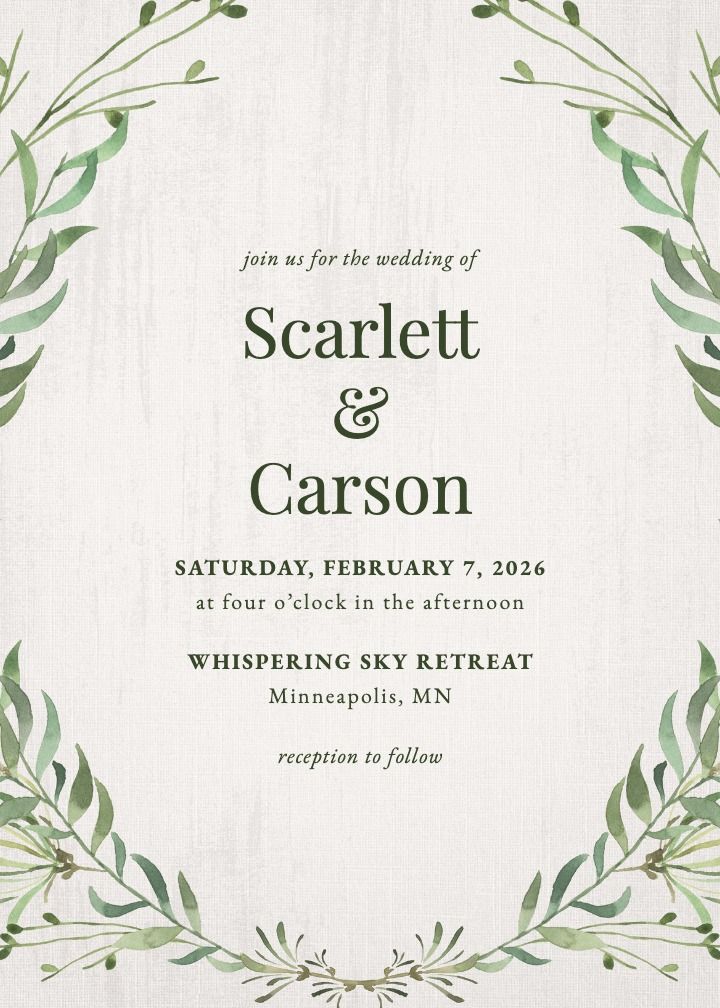
Watercolor leaves in green and white give this design a soft, classic greenery look that suits nearly any outdoor venue. The painted edges keep it romantic rather than rustic, so it works for garden parties and formal lawns alike. If you want botanical without committing to a specific plant personality, this is the gentle entry point.

Natural Greenery
Textured greenery in cream and green tones makes this the anchor pick for rustic and country garden weddings. The layered foliage has an almost linen-like depth that pairs well with kraft paper details, wood venues, and barn receptions. It reads relaxed and grounded without tipping into casual.

Bohemian Eucalyptus
Eucalyptus with a gold accent, this is the greenery design that bridges boho and formal. The metallic touch lifts the loose, free-spirited sprigs into ballroom territory, so it travels well between a backyard ceremony and a dressed-up reception. Choose it when your decor mixes pampas grass with candlelight.

Fern Forest
Layered ferns give this design a shaded, woodland depth that suits forest, mountain, and Pacific Northwest ceremonies. The denser foliage feels immersive rather than decorative, like an invitation pressed from the understory itself. It is the right call when the venue is literally among the trees.

Alpine Wreath
A green wreath frame on white gives this design a structured, symmetrical botanical look. The circular composition draws the eye straight to your names, which makes it a strong choice for couples who want greenery with formality. It also works naturally for winter and holiday-adjacent weddings.

Chrysanthemum
Dark botanical drama in black and purple, this design proves greenery-led stationery does not have to be light and airy. The moody palette suits evening ceremonies, formal garden estates, and autumn weddings with candlelit receptions. Pair it with a dark envelope liner and the whole suite feels theatrical in the best way.

Tropical Botanical
Lush tropical foliage with a monogram option, built for beach and destination weddings. The layered leaves have enough structure to feel polished, which keeps the design from reading as casual vacation mail. It sets the tone early for guests booking flights to somewhere warm.

Golden Paradise
Tropical botanicals with metallic gold detailing, for destination weddings that want a formal finish. The gold catches the eye in a way that suits resort ballrooms and sunset ceremonies equally well. If your dress code leans cocktail rather than barefoot, this strikes the right note.

Island Breeze
Breezy tropical greens with pink accents make this a relaxed, summer-island take on botanical. The palette feels like a linen shirt and a hibiscus cocktail, which is exactly the energy a laid-back beach wedding wants. It is a good match for casual destination celebrations and poolside welcome parties.

Tropical Blossom
Watercolor tropical florals and leaves show exactly where botanical and floral design overlap. The blooms share the stage with the foliage, so couples torn between the two styles get both. The painted texture keeps it soft, and the color range gives you room to pull accent shades into your decor.

Succulent Sunset
Watercolor succulents in blue, purple, and pink make this the pick for desert and Southwest weddings. The sunset palette echoes dusk over the landscape, which gives the stationery a sense of place before guests even arrive. It pairs naturally with terracotta decor, agave accents, and open-sky venues.

Cactus Rose
A cactus and rose pairing in green and white offers a cleaner desert botanical option. The restrained palette keeps the desert theme sophisticated rather than kitschy, which matters if your venue is a modern ranch or a minimalist desert space. It is proof that a theme can be specific and subtle at once.
How to Choose a Botanical Style for Your Wedding
With the sub-styles laid out, the choosing gets easier. Three decisions do most of the work: which plants match your setting, which art treatment matches your formality, and how loud you want the greenery to be.
Match the Foliage to the Venue
The strongest botanical invitations feel like a preview of the ceremony location. A fern-heavy suite promises a forest; a palm suite promises a shoreline. When the paper and the place agree, guests arrive already in the mood you intended.
Use this quick mapping as a starting point, then let your own flowers and decor refine it:
| Venue or setting | Foliage family | Palette direction |
|---|---|---|
| Garden or estate lawn | Eucalyptus, mixed greenery, wreaths | Soft greens with cream or white |
| Greenhouse or conservatory | Ferns, trailing vines, dense foliage | Deep greens, botanical illustration tones |
| Forest or mountain | Ferns, evergreen, woodland sprigs | Dark green with natural cream |
| Beach or tropical resort | Palms, monstera, tropical leaves | Bright greens with coral, pink, or gold |
| Desert or Southwest | Succulents, cacti, agave | Sage greens with terracotta or sunset hues |
| Formal evening garden | Dark botanicals, structured wreaths | Black, deep purple, or metallic accents |
Season matters as much as venue. Spring and summer suites can carry brighter, looser greenery, while autumn and winter weddings tend to suit deeper greens, wreaths, and evergreen structure. If you are still deciding between settings, browsing real outdoor wedding ideas can help you picture how the stationery, ceremony, and landscape will work together.
Watercolor vs. Illustrated vs. Photographic
The art treatment changes the mood as much as the plant choice. Watercolor botanicals feel soft and romantic, with visible brushwork and blended edges. Flat illustration feels modern and graphic, with cleaner shapes and bolder color blocks. Fine line illustration, especially in black and white, reads as minimal and editorial.
Photographic and realistic treatments are rarer in botanical stationery but do appear, usually as a full-bleed foliage backdrop. As a rule of thumb: watercolor for romantic and garden weddings, illustration for modern and playful ones, line art for minimalist ones.
Greenery as Neutral vs. Greenery as Statement
Decide early whether the greenery is a frame or the main event. A single eucalyptus sprig in a corner behaves like a neutral: it softens the design without demanding attention, and it coordinates with almost any decor. Dense, edge-to-edge foliage is a statement: it commits you to the theme, and your flowers, linens, and signage should follow its lead.
Neither is better. Neutral greenery gives you flexibility later in planning; statement greenery gives you a strong identity from the first envelope. If your venue supplies the drama, let the invitation stay quiet. If the venue is a blank canvas, let the invitation start the story.
Greenery-led designs are also kind to a stationery budget in a practical way: they coordinate with almost any floral decision you make later, so you will not be repainting the theme if your florist swaps peonies for dahlias. Green is the most forgiving accent color in wedding decor, and a botanical suite keeps working even as other plans evolve.
Wording and Details for Botanical Invitations
Botanical designs often signal an outdoor or garden ceremony, and outdoor ceremonies come with practical wording needs that indoor ballroom weddings can skip. The invitation suite is the place to handle them gracefully.
For the invitation itself, standard formal wording works perfectly well with greenery artwork; the design supplies the personality, so the text can stay classic. If your ceremony is in a garden, greenhouse, or natural setting, a small locational phrase does a lot: “in the conservatory gardens” or “beneath the old oaks” gives guests a mental image and a dress code hint at once. Our guide to wedding invitation wording walks through the full structure line by line.
A wording snippet for a garden ceremony, kept classic:
Together with their families
Amelia Rose Carter and Daniel James Okafor
request the pleasure of your company
at their marriage in the conservatory gardens
Saturday, the twentieth of June
at half past four in the afternoon
The phrase “in the conservatory gardens” does quiet work here. It tells guests the setting, hints at the dress code, and matches the greenery on the card without a single extra sentence.
Enclosure cards carry the outdoor logistics. Three additions are worth considering:
- Weather plan: a short line such as “The ceremony will move indoors in case of rain” saves dozens of guest questions.
- Footwear note: “The ceremony takes place on grass” is a kindness guests remember.
- Directions and parking: garden venues and private estates often need clearer wayfinding than hotels do.
For the response card, keep it simple and consider collecting replies online instead. Digital RSVPs remove the return-envelope math entirely, and phrasing matters less than clarity: a deadline, a meal question if you need one, and a link. These RSVP wording examples cover formal, casual, and online-only versions.
Carry the Greenery From Invitation to Wedding Day
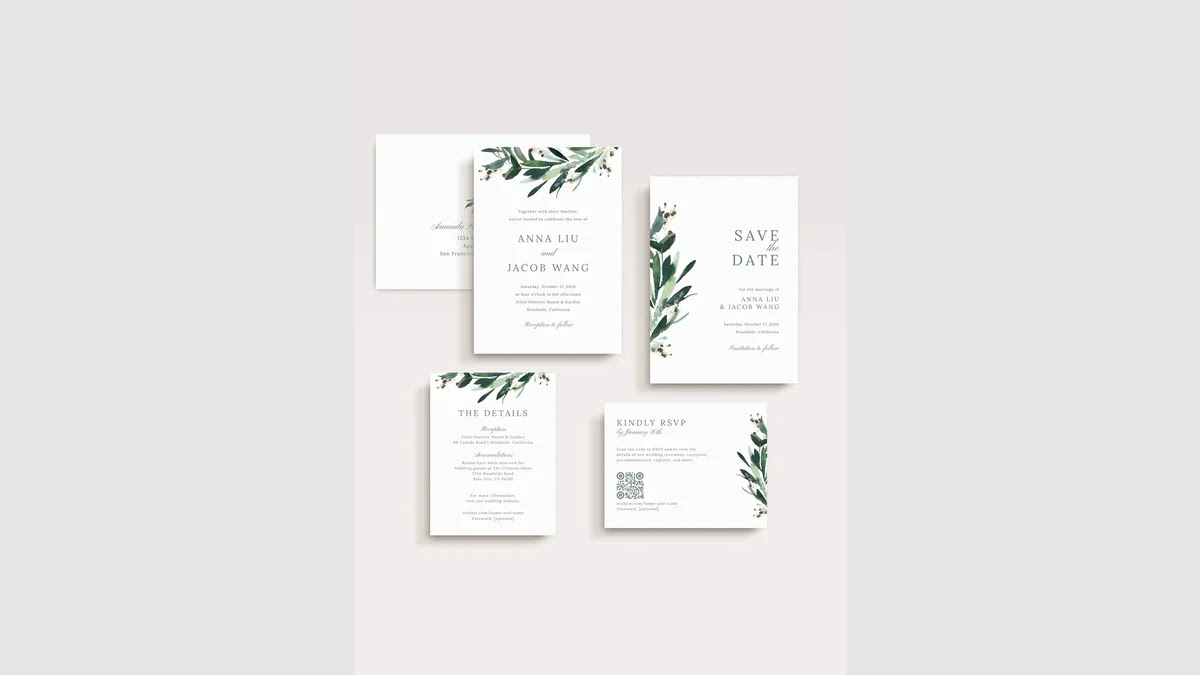
The biggest advantage of choosing a botanical design on a platform with matching formats is consistency. Guests meet the same eucalyptus sprig on the save the date, the invitation, the wedding website, and the thank you card. The theme stops being a single pretty card and becomes a thread that runs through the whole celebration.
Practically, that continuity works like this. Send the design as a printed invitation for the households that expect paper, and as a digital invitation for international guests, last-minute additions, or save the dates that need to move fast. Both versions use the same artwork, so nobody feels like they received the lesser version.
The same motif can carry onto your wedding website, where guests find the schedule, travel details, registry, and RSVP form in one place. When the website matches the invitation in their hand, guests trust it faster and navigate it more willingly, which means fewer texts to you in the final weeks.
RSVP tracking tied to the invitation closes the loop. Responses land in the same guest list you used to address the envelopes, meal choices stay attached to the right names, and reminders go only to the households that have not replied. Address collection works the same way: request addresses digitally before you print, and the guest list stays current without a spreadsheet.
The coordination extends past the wedding day. Thank you cards in the same design let you close the loop with guests in the visual language they have seen since the first announcement. Matching enclosure cards carry rehearsal dinner details or welcome party information for destination weekends, again in the same foliage.
None of this requires extra design work. You choose the botanical artwork once, and every piece that follows inherits it.
Frequently Asked Questions
What are botanical wedding invitations?
Invitations that use greenery, leaves, ferns, palms, succulents, or botanical illustration as the central design element. The category ranges from simple eucalyptus sprigs to dense tropical foliage, and often overlaps with floral designs when blooms share the layout.
What wedding themes go with botanical invitations?
Garden, greenhouse, outdoor, forest, tropical, desert, and rustic weddings are natural fits. Greenery-led designs also work for formal weddings when paired with metallic finishes or restrained color palettes.
What is the difference between botanical and floral wedding invitations?
Floral invitations make flowers the subject. Botanical invitations make foliage the subject: leaves, vines, ferns, grasses, and branches, with flowers playing a supporting role or absent entirely.
Can I send botanical wedding invitations digitally?
Yes. Joy offers botanical designs as both printed cards and digital invitations with online RSVP tracking. Digital sending works well for save the dates, international guests, and last-minute additions.
What should match my botanical wedding invitations?
Save the dates, enclosure cards, thank you cards, and the wedding website. Using one design across all of them keeps the botanical theme consistent from the first announcement to the last thank you note.